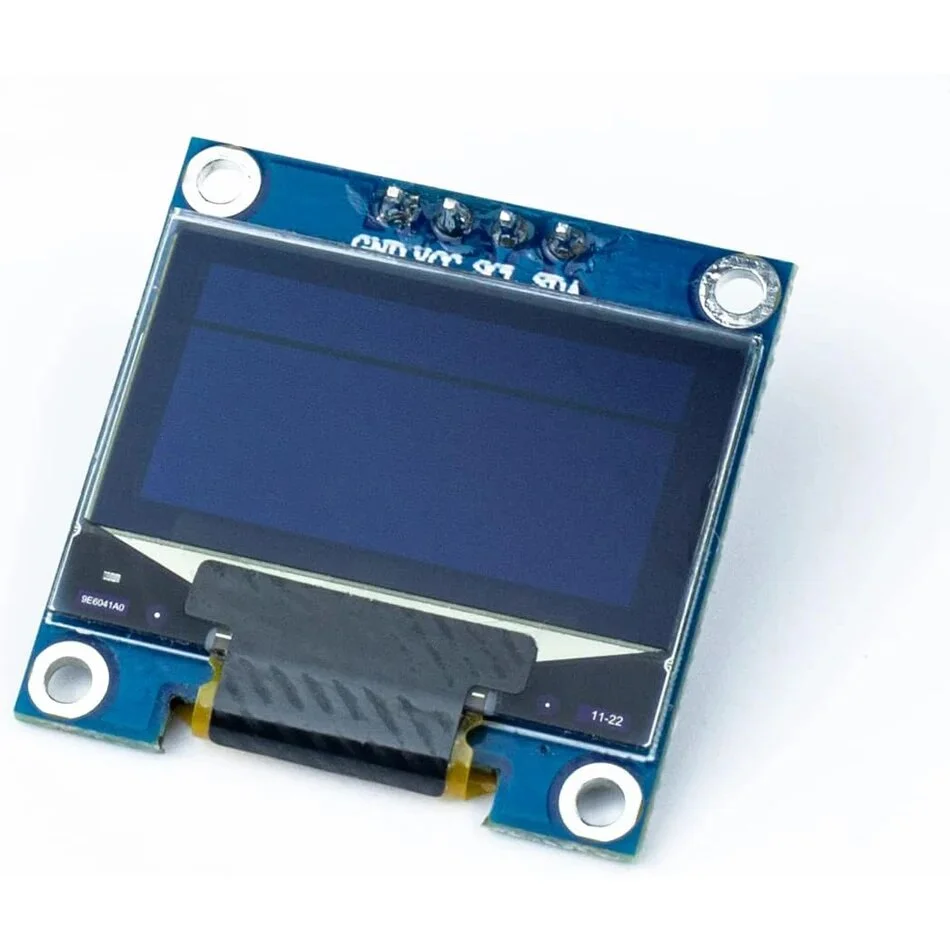
SSD1306 OLED Display
Generic
Monochrome 128×64 OLED display based on the SSD1306 controller. Features low power consumption, excellent contrast and simple I2C communication.
Specifications
| Controller | SSD1306 |
|---|---|
| Display Size | 0.96 inch |
| Resolution | 128 × 64 pixels |
| Display Type | Monochrome OLED |
| Interface | I2C |
| I2C Address | 0x3C (default) |
| Operating Voltage | 3.3V – 5V |
| Viewing Angle | >160° |
| Active Color | White (most common) |
Some links on this page are affiliate links. If you purchase through them, Embedded Nerd may earn a small commission at no additional cost to you. This helps support the website and allows us to continue creating free tutorials and guides. Thank you for your support!
Resources
You May Also Like

The SSD1306 OLED Display is one of the most popular display modules used in embedded electronics. Thanks to its excellent contrast, ultra-low power consumption and simple I2C interface, it has become the preferred choice for makers, students and professional developers alike.
Whether you’re building an IoT device, weather station, robotics project or portable instrument, the SSD1306 pairs perfectly with development boards such as the ESP32 DevKit, Arduino and Raspberry Pi.
If you’re getting started, follow our ESP32 OLED Tutorial – Wiring, Code & Display Guide to learn how to connect the display, install the required libraries and display your first graphics.
Features
- 128 × 64 monochrome OLED display
- SSD1306 controller
- I2C communication interface
- Default I2C address 0x3C
- Compatible with both 3.3V and 5V systems
- High contrast and excellent readability
- Wide viewing angle
- Very low power consumption
- Compact 0.96-inch module
- Extensive software support
Why Choose the SSD1306?
Unlike traditional LCD displays, OLED technology does not require a backlight because each pixel generates its own light. This produces deep blacks, exceptional contrast and excellent visibility while consuming significantly less power.
The SSD1306 has become the industry-standard OLED display for embedded systems thanks to its reliability, affordable price and excellent compatibility with modern development boards. Whether you’re displaying sensor readings, system status or custom graphics, it provides a simple yet powerful solution.
I2C Communication
The SSD1306 communicates over the I2C bus, requiring only four connections:
- VCC
- GND
- SDA
- SCL
Most modules use the default I2C address 0x3C, although some versions are configured as 0x3D.
If your display isn’t detected, our I2C Scanner Tutorial shows you how to identify the correct device address and troubleshoot common communication problems.
Applications
The SSD1306 OLED Display is widely used in embedded projects, including:
- IoT devices
- Weather stations
- Sensor dashboards
- Home automation
- Robotics
- Battery-powered electronics
- Portable instruments
- Data loggers
- Menu systems
- Debug displays
Its compact size and low power consumption make it an excellent companion for ESP32 and Arduino-based projects.
Software Support
One of the SSD1306’s biggest strengths is its excellent software ecosystem.
Popular libraries include:
- Adafruit SSD1306
- Adafruit GFX
- U8g2
- SSD1306Wire
- ESPHome Display Component
These libraries make it easy to display text, icons, graphics and animations with only a few lines of code.
Compatibility
The SSD1306 OLED Display is compatible with many popular development platforms, including:
- Arduino Uno
- Arduino Nano
- ESP32 DevKit
- ESP8266
- Raspberry Pi
- STM32
- RP2040
- Teensy
Thanks to its standard I2C interface, integrating the display into new or existing projects is quick and straightforward.
Project Ideas
The SSD1306 is suitable for countless embedded applications, such as:
- Smart clocks
- Battery monitors
- Wi-Fi status displays
- Environmental monitoring
- Sensor dashboards
- Portable measurement devices
- Home automation controllers
Looking for a practical project? Our ESP32 Snake Game with MPU6050 and OLED Display demonstrates how to combine an SSD1306 display with the MPU6050 to create a fun motion-controlled game.
Related Tutorials
To get the most from your SSD1306 OLED Display, we recommend these guides:
- ESP32 OLED Tutorial – Wiring, Code & Display Guide
- I2C Scanner Tutorial
- MPU6050 Arduino Guide
- ESP32 Snake Game with MPU6050 and OLED Display
You can also explore our complete Products collection and discover more components in our Recommended Hardware guide.
Final Thoughts
The SSD1306 OLED Display remains one of the best display modules available for embedded systems. Its combination of low power consumption, sharp image quality, affordable price and extensive software support makes it suitable for everything from beginner projects to advanced IoT applications.
Whether you’re displaying sensor data, creating user interfaces or building your next ESP32 project, the SSD1306 is a reliable and versatile display that continues to be a favourite within the embedded development community.